Located below Saxon Heights to the East of the school and situated about half a mile north-west beyond the edge of the suburbs of the city of Wessex lies St. Mary Mede, a small market town with a local population of 5,950 people.
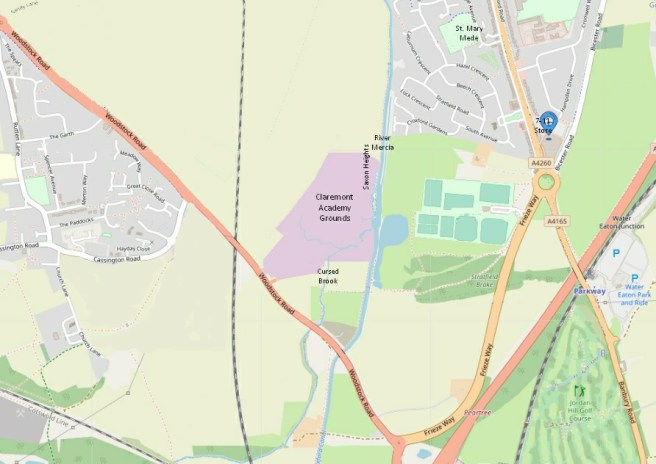
The town is a retail and leisure centre for its area, with a supermarket and numerous shops including branches of a number of national chain stores. It has a number of public houses, a small cinema and a theatre.
There is a weekly market every Wednesday, the ”Costume Parade” held in June and the “Mop Fair” in September. There is a single Wendy’s fast food restaurant in the town and rumours that a McDonalds will open in a closed bank building in the town centre.
The town has three schools; Claremont Academy (previously St. Thomas Aquinas Roman Catholic School and later Claremont Grammar), St Mary’s Church of England Primary School and St. Mary Mede Secondary School.
St. Mary Mede Golf Club is the oldest in Wessex. The course was started in 1890 on St. Mary Mede Common.
St. Mary Mede Rugby Union Football Club first XV plays in the Southern Counties North League and was the league champion for the 2007–2008 seasons. St. Mary Mede Town Football Club used to play in the Hellenic Football League premier division. St. Mary Mede Town Cricket Club plays in Wessex Cricket Association Division 6. The town also has a bowls club.
St. Mary Mede has a Women’s Institute, a Rotary Club and a RAF Base on the outskirts of the town , RAF base St. Mary Mede.
History
The Stairway Stones, a stone circle 2.5 miles (4.0 km) north of St. Mary Mede and the Great Rock on Saxon Heights are evidence of prehistoric habitation in the area.
The Mede in the town’s name means “drinking honey” clearly indicating that the area has been the site of a brewery and marketplace since at least the time of the Saxon invasion in the 400’s.
It is not clear where the main Saxon settlement was, but Rev. Anthony Blair, Professor of Medieval History and Archaeology at the University of Wessex, suggested in 2000 at a lecture in St. Mary Mede Town Hall that Westbury to the south, was in Anglo-Saxon times a more important minster town that St. Mary Mede and the town had a pastoral relationship with Westbury.
St. Mary Mede began as a small settlement at the foot of a hill on which stand the motte-and-bailey St. Mary Mede Castle. Only the earthworks of the castle remain.
The parish church of St. Mary the Virgin was built on the hill next to the castle. Parts of the present building may date from the 12th century. It certainly retains features from the 13th and 14th centuries. The nave was largely rebuilt in about 1485 with a clerestory in the Perpendicular style. This rebuilding is believed to have been funded by John Ashfield, a wool merchant, making St. Mary’s an example of a “wool church”. The bell tower was rebuilt in 1825 and has a peal of eight bells.
In the Middle Ages wool production made Wessex one of the wealthiest parts of England. Many of the medieval buildings built in the town as a result of that trade still survive. It became the new centre of the town and remains so today.
Later, sheep farming was largely displaced by arable, but agriculture remained important in this part of the Wessex Cotswolds. Many of the original houses around the market place were rebuilt in the 18th century with fashionable Georgian frontages.
An inscription on the alms-house records that they were built in 1640 as “The work and gift of Henry Cornholme, gent”.
Several battles occurred in and around St. Mary Mede during the English Civil War and the town and nearby estates were severely damaged, particularly during the Battles of Saxon Heights (1645) and (1649).
St. Mary Mede was also to witness at least one (a Justina Vervaine) and possibly a number of witch-burnings as Witchfinder-Genera1 Lucius Tarlbot pursued and persecuted witches throughout the 1640’s.
In 1745 an advanced force of Jacobite troops reached the outskirts of the city of Wessex. Most of the population fled however the celebrating Jacobites ransacked the estates around Saxon Heights and burned them to the ground.
In 1796 James and William Hitchman founded Hitchman’s Brewery in West Street. In 1849 the business built a larger brewery in Albion Street that included a malthouse and its own water wells. Three generations of Hitchmans’ ran the brewery, but in 1890 Alfred Hitchman sold the business as a limited company. The new company grew by buying other breweries in 1891 and 1917. In 1924 it merged with Banbury Brewries, and in 1931 the brewery in St. Mary Mede closed.
Other industries in the town included a wool mill, a glove-making factory, a tannery and an iron foundry.
St. Mary Mede had a workhouse by the 1770s. In 1836 the architect George Wilkinson built a new, larger workhouse. It had four wings radiating from an octagonal central building, similar to Witney workhouse, which also was built by Wilkinson. The architect G. E. Street added a chapel to St. Mary Mede workhouse in 1856–57. It ceased to be a workhouse in 1929 and became a hospital in the Second World War. The National Health Service took it over in 1948, making it St. Mary Mede’s Hospital which later served as a psychiatric hospital. The hospital was closed in 1983 and has since been redeveloped as private residences.
The St. Mary Mede Railway opened in 1855. In 1951, British Railways withdrew passenger services between St. Mary Mede and Wessex. In 1962 BR closed St. Mary Mede railway station and withdrew passenger services and freight traffic, and thereafter dismantled the line. The disused railway tunnel is now bricked up at both ends to prevent access.
In May 1873, rioting took place following the conviction and sentencing of the Marley Martyrs, fifteen local women accused of trying to interfere with strike breakers at a farm.
Bliss Mill, on the western side of the town, was built as a tweed mill in 1872. In 1913 to 1914 the millworkers struck for eight months. The mill closed in 1980 and has since been converted into flats. It remains a local landmark, clearly visible from Wessex Road.
In 1891 St. Mary Mede was the scene of a murder of a young lady highly reminiscent of the butchery carried out by Jack the Ripper a couple of years earlier. The murderer was never found and the circumstance behind the murder was hushed up to prevent a public outcry.
On the 13th October 1913 the town of St. Mary Mede and St. Thomas Aquinas’ School witnessed a number of mysterious disappearances with people claiming that they saw the missing people vanish before their eyes in a shroud of green light. The disappearances ended at the same time as the disappearance of one of the teachers, John Smith the following morning. It should be noted that local rumour also records that one of the housemaids, Martha apparently disappeared from the school at the same time and that there had been complaints about over-familiarity between Martha and Mr Smith in the days prior.
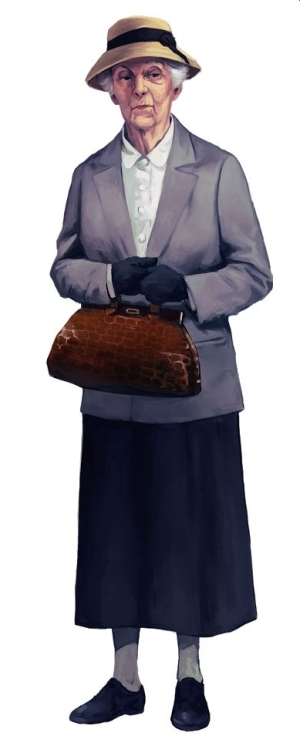 The town was again in the media spotlight in the 1950’s when a local spinster, Miss Maple was eventually arrested and charged with the murder of at least 20 people. Not only was this the first example of a murderer changing their modus operandi every time though in each case she managed to frame someone else for the murder. Several innocent people were hanged before Miss Maple was finally arrested and eventually hanged herself. At the trial, it became clear that in almost every murder, she had been actively involved in “investigating” her own murder cases; including interfering with incriminating evidence and in several high profile cases the local Police allowed her to directly accuse her chosen “murderers” and was the prime witness in their court cases.
Today her cottage has been turned into a Murder Museum; much to the annoyance of local residents who would rather the world forgot their most famous resident.
The town lost its status as a municipal borough in 1974, when the Local Government Act 1972 made it a successor parish within the district of West Wessex.

 Growing up Meta, UK-Style!
One thought on “The Village of St. Mary Mede”