
It had been a very, very, long week, even though it was still only Wednesday. Gus and Chris were walking quietly back to their ‘cell block’ after school, both lost deep in their own thoughts.
Chris was focusing on mentally trying to hack his new replacement commlink, though he also desperately wanted to try to figure out why Shini had access to a HCP unit, and one that had been fully unlocked at that.
He’d previously known about the built-in Baby Monitor protocol and had already worked out how to switch it on and off without automatically alerting anyone. The Baby Monitor Protocol allowed the school authorities to listen in through the suit even when Comms was switched off or not present, and allowed the school to track his location using direction and strength of signal, though it would need access to multiple cell towers to triangulate a precise location.
What he hadn’t realised previously, was that there was another program that interfaced with and had the capacity to activate specialist equipment built into their practice suits. Apparently, they would be told about the extra built-in facilities either when needed or once they’d proved ‘responsible’ enough. What really annoyed him was that Shini who was two years younger than him had already known about this.
Who’d named these things anyway? The activate program had been baptised ‘Training Wheels’ by some smart-Alec. So far, he’d discovered that it allowed the teachers to activate a health monitor hidden in their suits to enable them to check their vitals. It could also turn their costumes into an emergency skinsuit with a hidden transparent hood-like helmet, though for it to function for more than about five minutes it apparently would need an additional external life support system attached. Was it sufficient for use in the vacuum of space? He wasn’t sure he wanted to ever find out.
At least he now knew how to fully unlock his replacement earpiece – Training Wheels also limited what facilities he could access through his commlink; including all the pre-programmed channels such as listening into Trouble Alert (though he wouldn’t be able to do more than listen in without being locked out by Dispatch as an unauthorised user). Channel 1 was set to the school’s HCP’s own encrypted frequency and had been the only channel they’d previously been authorised to have access to (with Chris now able to access channel 4’s Internet Over Voice Protocol).
(See https://uksuperhero.com/2017/04/02/bluebook-session-1b-earpieces/
for further information)
He was sure there were other facilities built-in, but he was yet to figure out what they did.
He sighed, he knew he was deliberately trying to distract himself from what was really on his mind, Tara and Tabitha. He’d wanted to visit them in hospital, but the school had refused. Thankfully, they were only being kept in for a few days for observation and were due to be released at the weekend.
His theory that the neurotoxin would eventually wear off seemed to have been correct, pity that they’d gone into cardiac arrest before then. Maybe they’d be really grateful he’d saved their lives? Possibly, he might need to drop a hint or three as to the identity of their saviour? Perhaps they would want to show their appreciation?
And if they did, perhaps they would be repelled to discover ‘he’ was actually a ‘she’? Nope, that way lead to possibly being publicly outed, rejected by everyone and all sorts of personal problems – was he ready for that? Maybe he needed to have another chat with Jaden?
—o0o—
Meanwhile, Gustav had stopped brooding long enough to look over at the ongoing Chapel repairs. The area was currently out of bounds while the workers repaired the damage. He also noticed they were adding another cell tower to the rear of the building; for better coverage or more accurate tracking of the students, he wondered? The repair work itself was going well. Apparently, the damage had looked a lot worse than it really was and had consisted of mostly replacing the pews and repairing the damaged windows and door frames in the reception area.
Thankfully, young Chris had got off lightly. He’d only been done for breaking into the chapel and no one was blaming him for what had happened afterwards, though Gus’ was a bit concerned that he might be blaming himself for the consequences. Ashley still hadn’t spoken to young Chris since, though whether that was due to embarrassment or anger, Gustav wasn’t sure.
It was also rumoured that someone’s parents had donated the cost of the repairs (though there was a counter rumour that it was actually one of the students who had donated the funds) which had probably helped.
His thoughts again wandered back to his Carpathian Coup plans. The school unsurprisingly had refused to support his proposals but had reluctantly agreed to give him some training, advice and education beginning with some extracurricular classes earlier that day.
Lunchtime, earlier that day
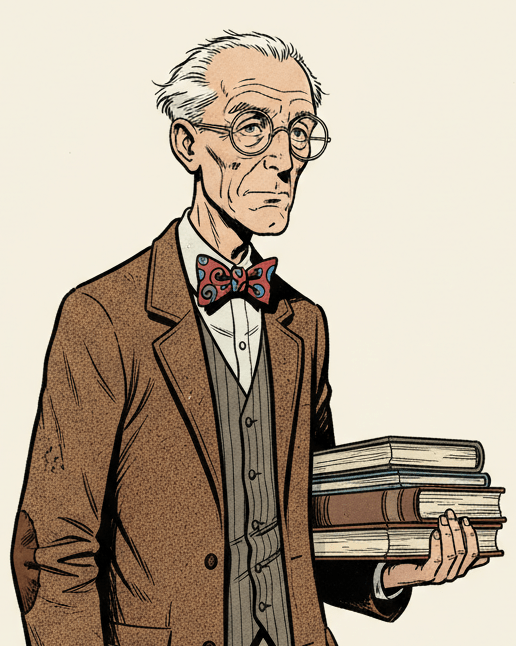
Gustav really wasn’t sure what help this would be, but he’d rushed his lunch anyway and headed to Mr Herne’s class. There he found his history teacher waiting. Mr Herne was tall, slightly thinning on top, with round spectacles and a bow-tie under a tweed jacket. He always looked like a professor who’d just escaped from an old 1930s black and white film. He would apparently provide the background understanding he’d requested.
Dr Lockheart (and surprisingly ‘Also’ Rhan) would provide him with training in mental shielding; they’d even offered to look at programming possible scenarios for him Down Below.
Mr Herne gestured for him to take a seat. “Let me be clear from the beginning Mr Jaeger, as part of the Special Curriculum staff I am aware of why you are requesting these sessions and I will not support you directly in achieving what I believe to be unrealistic and potentially dangerous plans but I have agreed to act as your advisor. There are several things we need to be clear on before we look at what has worked and what hasn’t, as far as regime changes around the world.
Therefore, I will be discussing why I believe coups are a very bad idea and why they often fail, as well as helping to clarify whether you actually have any claim on the ‘throne’ so to speak.
Let me deal with the latter first. There are no obvious links between the Bathory and Sylvestri von Ruthenia lineages. I am assuming from what Ms Van Helsing has said that your mother was a member of the House of Bathory and a vampire?”
Seeing the look of surprise on Gustav’s face he continued, “Yes, I believe in vampires Mr Jaeger. I’m old-fashioned that way, I still believe in good and evil and, yes, in Heaven and in Hell.
Is the Baroness a vampire? That seems unlikely. She is often seen in the midday sun, eating food that contains garlic and while she has been shown at times to be cruel, there is no record of her ever drinking blood.”
Gustav sat deep in thought, his grandmother and mother were vampires but apparently, the Baroness Natasha wasn’t based on her lifestyle, but she did appear to have some sort of powers at her disposal.
Mr Herne continued, “But her family name does give us some clues as to whom she might be, but for the moment there are no indications that would clearly show that the two families are connected in any way that would help your cause.”
He paused as though considering his options. “I will discuss the Sylvestri lineage another time but for the moment let me say that from what Ms Van Helsing has uncovered, your grandmother is also a vampire who may have assimilated her own daughter. If she is correct, then your grandmother is most likely Erzsébet Báthory, the Hungarian Countess also known as the Blood Countess.”
He reached over, pulled a book from his shelf and flung it onto Gustav’s desk. The title read ‘the Dynasties of Hungary.’
Before Gustav could open the cover, Mr Herne continued, “Erzsébet, Elizabeth was born in 1560 and she did in fact have two sisters older than her whose fate is unconfirmed in history. There was a rumour that they were both killed in a peasant rebellion when Elizabeth was a child though of course it’s possible that one of them somehow escaped but If so, why did she not just return to her family afterwards? If she did survive and did elect to stay hidden for some reason then she could have gone on to become the progenitor of the Sylvestri von Ruthenia line. However, there is no way to be sure, so despite what you heard I do not believe your claim to the Carpathian throne would be accepted by anyone.
However, Bathory was an important and noble name in its own right. Elizabeth was engaged at age 10 to Ferenc Nádasdy, the son of Baron Tamás Nádasdy de Nádasd et Fogarasföld and Orsolya Kanizsay in what was probably a political arrangement within the circles of the aristocracy.
It’s worth noting that according to Ms Van Helsing your mother seemed to have become a vampire in her early thirties, however all of Elizabeth’s official children, including her eldest, all apparently survived to a good age before dying.”
He reached over and opened the book he’d just given to Gustav and began to read aloud, his accent near-perfect. “Elizabeth’s eldest daughter, Anna Nádasdy or possibly Anastasia, was born in 1585 and was later to become the wife of Nikola VI Zrinski. Her other known children include Orsolya (Orsika) Nádasdy who would later become the wife of István II Benyó, Katalin (Kata or Katherina) Nádasdy, András Nádasdy, and Pál (Paul) Nádasdy, father of Ferenc II Nádasdy.”
He closed the book and looked at Gustav, “None of them fit your mother; however, there are rumours that Elizabeth may have become pregnant with a child when she was only thirteen by a peasant boy – rumours that claim that child had also been called Anastasia. The child was supposedly given away to a local woman that was trusted by the Báthory family, the woman was paid for her act, and the child was taken to be raised in Wallachia which I’m sure you know is now part of Carpathia. The father was apparently castrated and then thrown to a pack of dogs. The validity of the rumour is, however, disputed.
Elizabeth was definitely guilty of serial murders, but there was no indication of her acting as a vampire in the historical records. According to the testimonies, Báthory’s initial victims were serving girls aged 10 to 14 years, the daughters of local peasants, many of whom were lured to Čachtice Castle by offers of well-paid work as maids and servants in the castle. Later, she was said to have begun to kill daughters of the lesser gentry, who were sent to her gynaeceum by their parents to learn courtly etiquette. Abductions were said to have occurred as well. The atrocities described most consistently included severe beatings, burning or mutilation of hands, biting the flesh off the faces, arms and other body parts, freezing or starving to death. Needless to say, she couldn’t keep all of these murders secret forever, and eventually the authorities were forced to act.
A trial and execution would have caused a public scandal and disgraced a noble and influential family (which at the time ruled Transylvania), and Elizabeth’s considerable property would have been seized by the crown. Thurzó, along with Paul and her two sons-in-law, originally planned for Elizabeth to be spirited away to a nunnery, but as accounts of her murder of the daughters of lesser nobility spread, it was agreed that Elizabeth Báthory should be kept under strict house arrest and that further punishment should be avoided.
Báthory was imprisoned in Čachtice Castle, placed in solitary confinement, bricked in a set of rooms, with only small slits left open for ventilation and the passing of food. She remained there for four years until her death on the evening of 21 August 1614. She was supposedly buried in the church of Čachtice but due to the villagers’ uproar over having the Blood Countess buried in their cemetery, her body was moved to her birth home at Ecsed, where it was interred at the Báthory family crypt. The location of her body today is unknown. Čachtice church or Čachtice castle do not bear any markings of her possible grave.
The most common belief these days was that of the countess bathed in her victims’ blood to retain her beauty or youth. This legend appeared in print for the first time in 1729, in the Jesuit scholar László Turóczi’s Tragica Historia, the first written account of the Báthory case.
There is nothing in the histories to confirm that Elizabeth ever became a vampire or when, but Ms Van Helsing believes she did become one. She has confirmed that one of the Vampire houses, clans(?) is called House Bathory and is overseen by a female vampire of great power and age. She believes Elizabeth was somehow infected by one of her victims and subsequently sought out her eldest daughter who she also made a vampire. Why she never converted any of her other children is unknown.
If you want to know more about that, you need to ask Ms Van Helsing but it’s clear that if somehow the Sylvestri von Ruthenia line is descended from Elizabeth or her sister it would be extremely hard to prove or be believed and after all this time, how valid would it be anyway.” He looked at his watch.
“Sorry, I never meant to spend so much time discussing that aspect, but it is truly fascinating isn’t it? Anyway…”
He gathered some notes off his table and said with a smile, “I would like to start with a quote, if I may. Nelson Mandela once said that ‘Education is the most powerful weapon which you can use to change the world’, Mr Jaeger, remember that. If you still insist on taking this further, I recommend reading a book called Coup d’État. Despite its age, it details all the necessary ingredients to a successful regime change, none of which are available to you currently.
Carpathia will not be an easy country to overthrow, Mr Jaeger. The vast majority of its citizens are in favour of the Baroness, possibly because everything that goes wrong in the country is blamed on the Government and not on her.
There has been only one attempt at a regime change since Carpathia became independent, and it failed miserably. Why do you think that was, Mr Jaeger? Here are just some of the things you need to consider.
Despite its seemingly backwards nature, the state uses widespread facial recognition to track its citizens in the major cities. Its security use chest-mounted cameras linked to a database of citizens. That meant once the major conspirators were identified, they were quickly and brutally rounded up.
Many of the ministers in her Government refused to rebel, we don’t know why, but it’s rumoured that the Baroness has them addicted to a unique drug that only she has access to. They either didn’t want to risk losing their supply, or perhaps there are serious consequences to stopping?
After a bloody night of fighting, the attempted coup d’etat was decisively crushed as police, loyalist military units and crowds of civilian volunteers rallied behind The Baroness. The armed forces and the judiciary were purged of real and suspected enemies of the government.
Everyone involved in the coup were arrested and subsequently vanished, as did their parents, partners and children, even distant relations. What happened to them no one really knows, but it is assumed they were all executed. There is a rumour that her Security Chief has a room built out of the skulls of dissenters. Even if that isn’t true, the rumour circulated and people were left believing that any form of rebellion against the status quo would result in swift, brutal and deadly retaliation.
Generals are now appointed purely based on loyalty rather than competence. Commanders are regularly switched so that they cannot build a support base among the soldiers they lead. The regime imposes what to the rest of the world looks like an over-centralised and dysfunctional command structure. However, it is a structure, which makes it difficult for plotters to even meet without attracting the attention of the regime’s security services. It also drives wedges between officers and the rank-and-file through political indoctrination.
The secret police often employ agent provocateurs to smoke out potential ‘putschists’ by encouraging them to take part in bogus plots and then arresting and exterminating them. The Baroness also has her own parallel paramilitary forces that are better armed and trained than their regular counterparts, and manned by troops recruited on the basis of party, clan or ethnic loyalty to the Baroness. Many are believed to be meta’s.
You need to be aware that all the political leaders in Carpathia will do whatever keeps them in power. They don’t care about the “national interest”- or even their subjects – unless they have to. They are almost entirely driven by their own political survival – a view many would characterise as ‘cynical, but I fear is also accurate.’
So what are the basic requirements of a successful coup, Mr Jaeger?
Firstly, plotters have to be able to plan and organise the takeover of the state without alerting any loyalist colleagues in the armed forces, or the country’s security services.
Secondly, they will have to seize and dominate the state’s transport and communications network – roads, rail links, ports, airports, television, telephones and the media.
With communications, the would-be coup plotter might be guided by Lenin’s dictum that ‘the first act is to seize the telephone exchange and the telegraph office.’ In the age of Twitter and the smart-phone, it is no longer as easy to shut down attempts by the government to talk to the masses – or indeed to stop crowds rallying each other to defend the status quo.
Thirdly, they have to achieve a shock effect on the government. The Prime Minister, monarch, ministers, and senior civil servants must be either arrested (or perhaps killed), or at any rate they should be neutralised.
Fourthly, the coup needs to be executed with such speed that it becomes a fait accompli for potential opponents. Other elements of the armed forces and the security services must be left with the impression that the only choice they have is either futile resistance or acquiescence in the new order.
Finally, the coup cannot succeed unless it has either popular support, or the plotters can at least count on the general population being unwilling to defend the old order. Remember, the Baroness is an extremely popular figure so that would be extremely difficult to achieve.
The reality is that no one person, no matter how deserving, well known or driven, can successfully overturn a government on their own. Achieving a fait accompli is easier in theory than in practice, as the self-interest of those supporting your coup have to be taken into consideration.
There are certain common principles behind bettering the world – whether we are looking at the welfare of shareholders in publicly traded corporations, the quality of life for citizens in a democracy or the conditions under which billions live in oppressive and impoverished third-world countries. These commonalities need to be laid bare before we tackle the specifics of fixing particular problems in particular places.”
Suddenly the school bell rang and Gustav could hear several students starting to gather just outside the classroom door. Seems lunchtime was over and he had a second period of English to get to.
Mr Herne took off his glasses and began to wipe them with a cloth, “Looks like our time is up, Mr Jaeger. Next week, you will be the one asking the questions and explaining how you would surmount the problems. Meanwhile, it’s time for you to head to your own class.”

 Growing up Meta, UK-Style!